
How to Win at Bingo: Practical Tips for Beginners
Learn how to win at Bingo more often by staying focused, spotting patterns, and avoiding mistakes, with honest tips that never promise a guaranteed win.
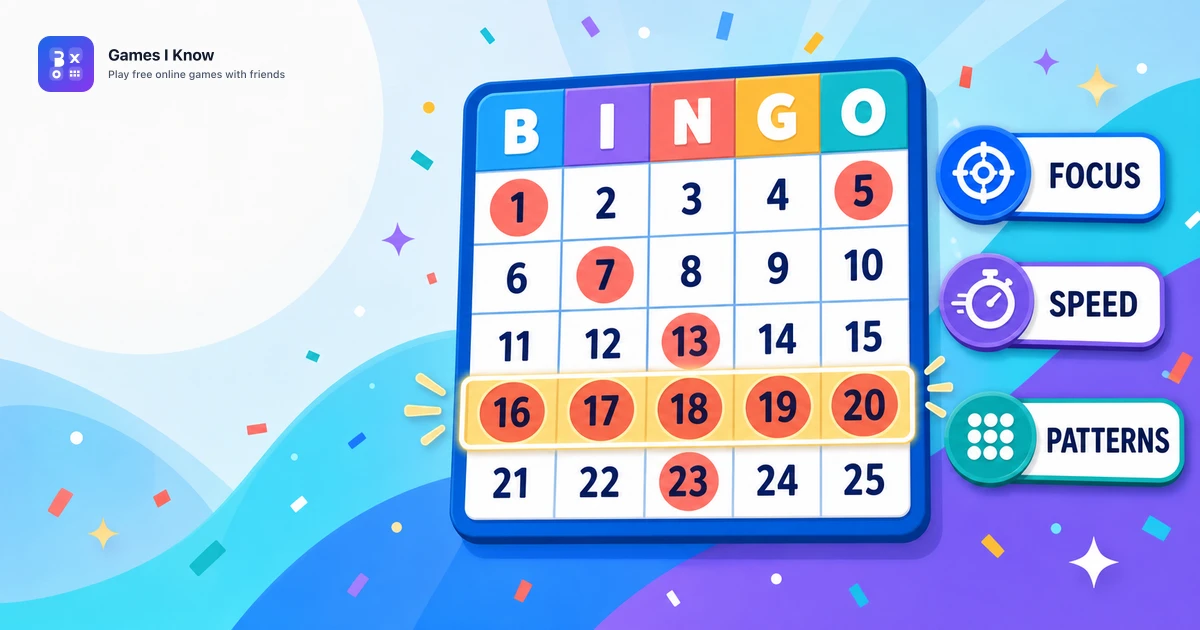
You cannot guarantee a Bingo win because the cards and called numbers depend mainly on chance. What you can improve is your execution: understand the target, follow every call, scan your card in a consistent order, spot completed lines quickly, and avoid preventable errors. Those habits do not control which numbers appear, but they help you make the most of the card you receive.
Quick answer: how do you win at Bingo?
To win at Bingo, complete the required pattern before the other players and make sure the win is recognized under that game's rules. There is no secret number system that makes a random call more likely. The most useful Bingo strategy is practical: know the winning condition, keep up with every number, use a reliable scan route, limit distractions, and play only as many cards as you can follow accurately.
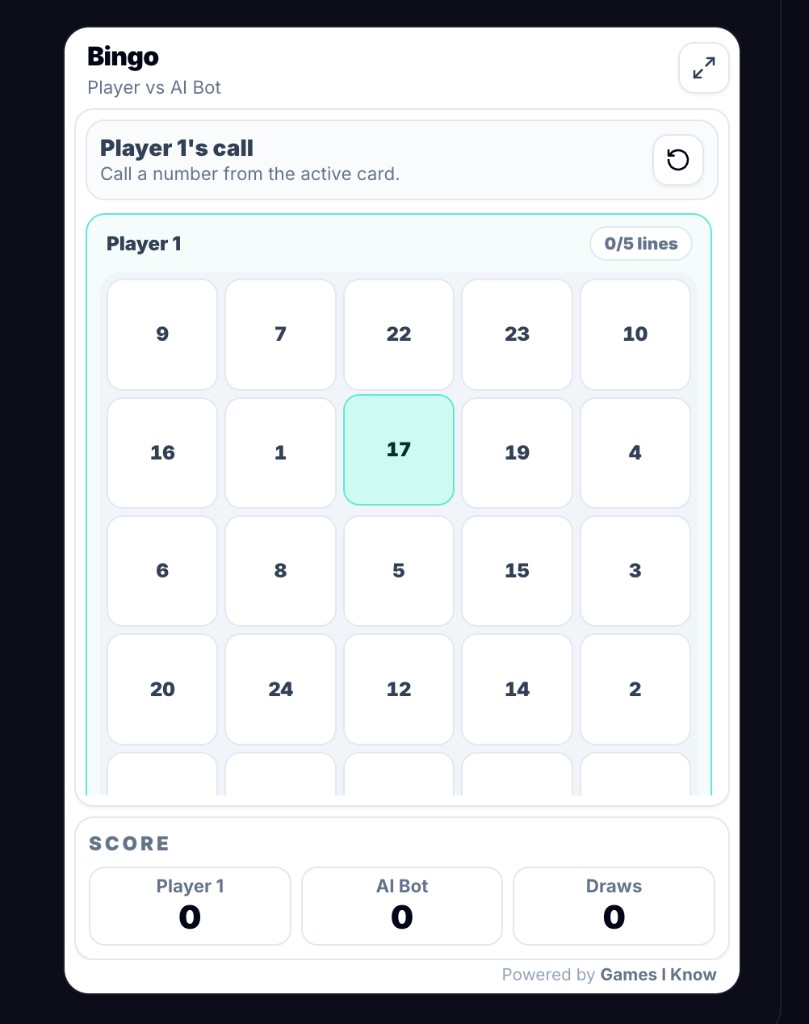
On Games I Know, each player receives one shuffled 5x5 card containing 1 through 25. Players take turns calling an uncalled number from the active card, the game marks that number automatically on every card, and the first player to complete five total rows, columns, or main diagonals wins. A shared finish is recorded as a draw. This is a free social browser game, not a real-money Bingo room.
Why Bingo is a game of chance: myth vs reality
Bingo begins with random information. You do not know which card you will receive or which eligible number will come next. Focus cannot turn an unhelpful call into a helpful one, and experience cannot force the missing square in a line to appear. That is why honest Bingo winning tips must separate the result from the way you manage the round.
| Myth | Reality | What you can do |
|---|---|---|
| Skilled players can predict the next number | Fair calls are not predictable from a recent sequence | React accurately instead of guessing |
| A lucky card design guarantees a better result | A card helps only if the random calls complete its target | Learn the pattern and monitor every valid line |
| Playing faster changes the calls | Speed does not affect which number appears | Use speed to avoid falling behind |
| A near win means the next round is more likely to pay off | Each new shuffled card and call sequence stands on its own | Reset your attention rather than chasing a previous result |
The useful form of skill is error prevention. In manually marked Bingo, a distracted player can miss a valid number or call Bingo late. In Games I Know Bingo, marking and line counting are automatic, so the skill shifts toward reading the board, choosing an effective number on your turn, noticing threats, and staying engaged with the rotating caller. Better habits protect your opportunity; they do not manufacture luck.
10 Practical Bingo Tips for Beginners
1. Confirm the win condition before play starts
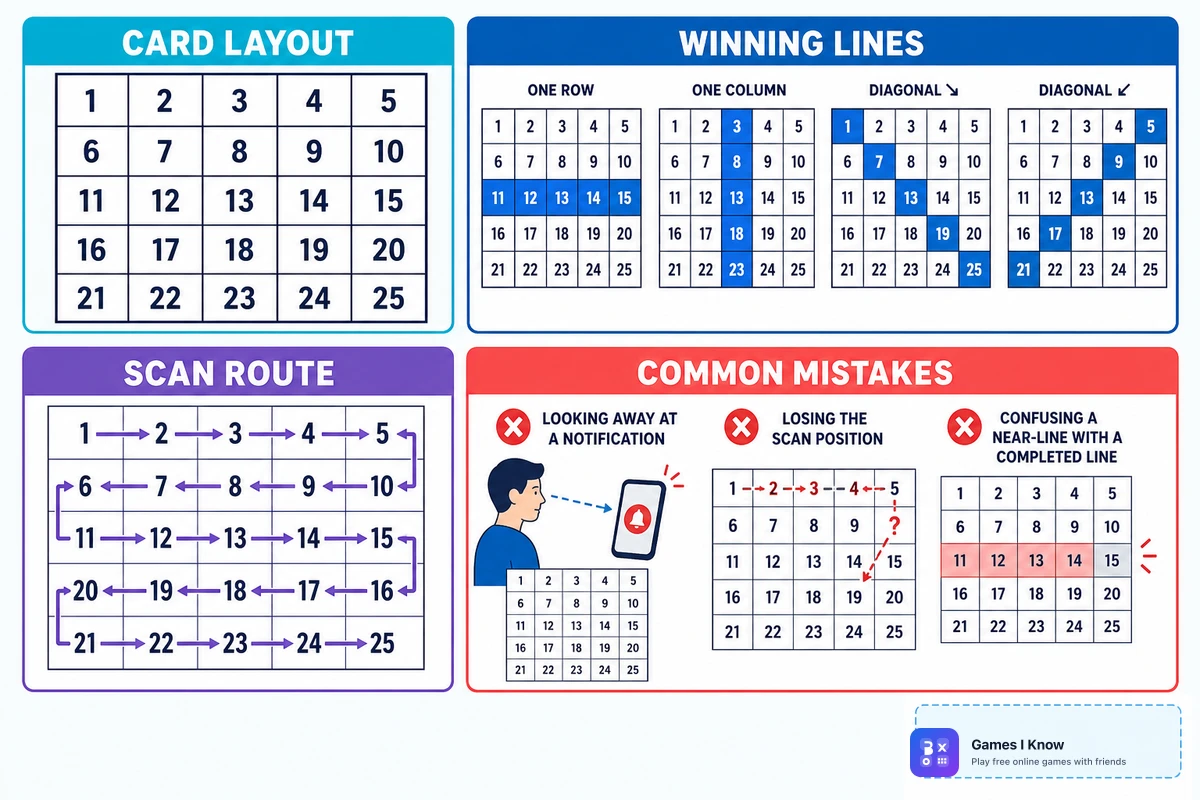
Do not assume every Bingo game ends with one horizontal line. A host may use rows, columns, diagonals, a special shape, a full card, or a required number of lines. Games I Know uses five completed lines, and a line can be any full row, full column, or either main diagonal. Knowing that target tells you what to watch.
2. Choose a pace you can follow comfortably
A faster game is not automatically a better game. Beginners improve more quickly when there is enough time to hear or read a call, find it, and verify the mark. If you are using paper cards, start with one. If you are online, learn the controls in a solo or AI round before joining a lively room.
3. Use the same scanning route after every call
Pick a route and repeat it: left to right across each row, top to bottom by column, or a gentle zigzag. Consistency matters more than the route itself. When your eyes always know where to go next, you are less likely to check one area twice and skip another.
4. Listen to or read the complete call
Reacting to half a call creates false starts. Let the full number register, repeat it silently once, then scan. Online, use the visible last-call display as a confirmation tool rather than relying on memory alone. On Games I Know, the Called panel keeps the complete 1-25 call history visible.
5. Watch near-complete lines without getting tunnel vision
A line with four marks deserves attention, but it should not consume all of it. Keep scanning the whole card because another row, column, or diagonal may improve first. A useful rhythm is full-card scan, then a quick check of the lines closest to completion.
6. Recognize valid Bingo patterns at a glance
Practice seeing the card as intersecting lines, not 25 separate squares. The center belongs to its row, its column, and both main diagonals, while a corner belongs to one row, one column, and one main diagonal. This does not make those numbers more likely to be called. It simply helps you notice how one mark can complete more than one line.
7. Reduce distractions before the first call
Silence nonessential notifications, close unrelated tabs, and place your device where the whole card is visible. In a family, classroom, or event game, finish rule explanations before starting. A ten-second setup prevents more missed calls than trying to recover after the room is moving.
8. Keep your card and controls organized
For paper play, keep cards flat, separate, and inside one field of view. Put the marker in your dominant hand and avoid covering unmarked numbers with your wrist. For browser play, use a comfortable zoom level and fullscreen when it makes the card easier to read. Games I Know uses large touch targets and a responsive card for mobile and desktop.
9. Stay attentive until the result is confirmed
Do not mentally end the round because another player looks close or because your card has started slowly. A later call can complete several lines at once. Continue following the official call history and wait for the game or host to confirm the finish.
10. Practice accuracy before chasing speed
Speed is the result of a repeatable process. Play a few free rounds where your goal is not simply to win. Instead, notice whether you followed every call, scanned the full card, and identified the valid lines correctly. Once those actions feel automatic, your pace improves without frantic clicking.
Beginner vs Experienced Bingo Player
| Situation | Beginner response | Experienced response |
|---|---|---|
| Rules are announced | Assumes the usual pattern | Confirms the exact target and when play ends |
| A number is called | Searches randomly | Uses the same scan route every time |
| One line is nearly complete | Stares only at that line | Tracks it while scanning the full card |
| The room gets busy | Speeds up and makes errors | Keeps a steady pace and uses the call history |
| The card starts slowly | Loses interest | Stays attentive because later calls still matter |
| The round ends | Credits or blames a secret system | Separates luck from correct execution |
Bingo mistakes that reduce your chances of keeping up
- Playing more paper cards than you can scan accurately. More cards are not useful if you miss calls.
- Changing scan direction from one call to the next and losing your place.
- Marking before the whole number is heard or read, then spending the next call correcting it.
- Watching only a promising row and overlooking a column or diagonal.
- Treating a near-line as complete without checking every square.
- Looking away to chat, answer a notification, or adjust settings during active play.
- Ignoring the current caller or turn prompt in a rotating-caller game.
- Stopping before the win is confirmed or missing a final call after another player reacts.
Games I Know removes several manual errors by marking a called number across every card and counting completed lines automatically. You still need to act when it is your turn to call. If a human caller waits too long, the full game can make an automatic call after the turn timer, which keeps the room moving but gives up your chance to choose the number yourself.
Online Bingo etiquette for friendly rooms
- Join with a recognizable, appropriate display name.
- Let the host explain the format before the first round.
- Take your turn promptly and do not hold up the room on purpose.
- Keep chat supportive and avoid flooding it while people are following calls.
- Do not complain that another player's lucky card was unfair.
- Wait for the game to confirm a win, then congratulate the winner and use the rematch flow if the group wants another round.
Etiquette matters because attention is shared. Teachers and event organizers can help by stating the target, expected pace, and chat rules before play. Families can appoint one person to help a new player for the first round. A calm room makes Bingo easier to follow and more enjoyable for everyone.
Common Bingo myths
Myth: some numbers are due
A number that has not appeared recently is not owed a turn. In a fair game, past rounds do not create a promise about the next shuffled card or sequence.
Myth: balanced high, low, odd, and even numbers guarantee a stronger card
A visually balanced card may feel reassuring, but it cannot determine which numbers will be called. Systems based on selecting particular number ranges do not provide a guaranteed Bingo strategy.
Myth: experienced players can control the result
Experienced players often look smoother because they know the rules, scan efficiently, and make fewer mistakes. That does not mean they can control a random card or every call.
Myth: a close loss makes a future win more likely
A close result can teach you that your process worked, but it does not build credit toward the next round. Treat a rematch as a fresh game.
Practice free online Bingo on Games I Know
Games I Know is useful for practice because it keeps the setup small and visible. Choose Create Room, Join Room, or Play with AI Bot from the browser lobby. A room host can share the room code and start after at least two participants are present. Rooms support up to five participants, and a solo player can add Bingo Bot instead of waiting for a friend.
During play, the current-caller prompt, last called number, full call history, 5x5 touch-friendly card, and B-I-N-G-O line tracker keep the essential information together. Calls mark every player's card automatically. The interface works in modern mobile and desktop browsers, includes fullscreen controls, and provides chat, reactions, rematches, result sharing, and a post-round recap. No signup or download is required for a standard room.
Related games & embeds
Explore Games I Know pages connected to this guide.
Frequently asked questions
Is there a trick to winning Bingo?
No trick can guarantee a Bingo win. Cards and calls are mainly governed by chance. The practical approach is to know the target, follow every call, scan consistently, and avoid preventable mistakes.
Is Bingo skill or luck?
Bingo is primarily luck because the card and call sequence determine the result. Skill helps with execution: staying focused, marking accurately where required, recognizing patterns, and acting promptly.
How can I get better at Bingo?
Practice one repeatable scan route, learn the valid patterns before starting, track near-complete lines without ignoring the rest of the card, reduce distractions, and prioritize accuracy before speed.
What are the best Bingo tips for beginners?
Start with one manageable card, confirm the winning pattern, listen to the complete call, scan the same way every time, use the call history, and stay attentive until the result is confirmed.
Does playing more Bingo cards increase your chance of winning?
Holding more distinct cards can cover more possibilities in some formats, but it also increases the work required to follow every call. For beginners, a smaller number of cards played accurately is usually the better practical choice. Games I Know gives each participant one card per round.
What Bingo patterns should beginners learn?
Learn the exact pattern used by your game. Common examples include rows, columns, diagonals, special shapes, and full-card games. Games I Know counts full rows, columns, and the two main diagonals, with five completed lines required to win.
Can I practice Bingo online for free?
Yes. Games I Know offers free online Bingo in a modern browser. You can create or join a room with friends, or practice against Bingo Bot without downloading an app.
Does Games I Know Bingo work on mobile?
Yes. The Bingo card and controls use a responsive, touch-friendly layout for modern mobile browsers, and the game also works on desktop. Fullscreen can make the card easier to follow on a smaller screen.
Related articles
August 12, 2026·12 min read
Online Bingo vs. Bingo Hall Games: Which Experience Suits You?
Compare online Bingo and Bingo hall games by convenience, atmosphere, pace, cost, accessibility, and social play to choose the right format.
April 22, 2026·3 min read
How to play Bingo online for the first time
New to browser Bingo? Learn how online Bingo works, how to host a room, and how to win faster on Games I Know.
April 26, 2026·3 min read
Best games to play with friends online
Explore free online games to play with friends directly in your browser, including Bingo, trivia, Tic Tac Toe, and Four in a Row. No login or download needed.
April 18, 2026·3 min read
Quick games to play online when you have 5 minutes
Discover quick browser games you can play online in just a few minutes. No login, no download - just open a game and start playing.
April 30, 2026·3 min read
Free online games with no download or signup
Find free online games with no download or signup. Learn what to look for, what to avoid, and which game formats start fastest.
May 1, 2026·4 min read
Fast free browser games for quick group play
Discover fast free browser games you can open in a tab with no download. Great picks for duos, small groups, and quick breaks on phone or desktop.
Get in touch
Questions about this topic?
Send support questions, embed requests, partnership ideas, or feedback. Your message is saved securely and forwarded to our support channel for review.