
Sudoku Mistakes Beginners Make (and How to Avoid Them)
Learn the common Sudoku mistakes beginners make, why guessing backfires, and how to use notes, scanning, and elimination to improve steadily.
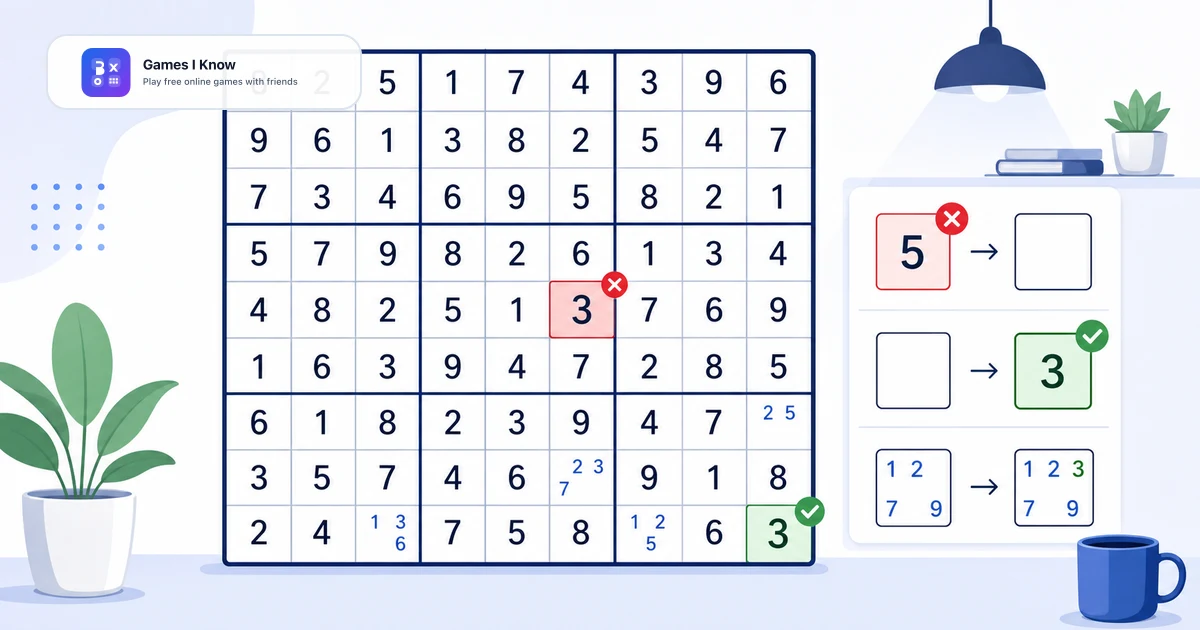
Most beginner Sudoku mistakes do not happen because the player is bad at logic. They happen because Sudoku quietly rewards habits that are slower than they feel: guessing, staring at one corner, filling notes too casually, or chasing speed before the board is ready.
This guide is for players who know the basic rules but still get stuck. We will focus on practical Sudoku mistakes, why they happen, and what to do instead. When you want to practice, Games I Know Sudoku gives you a browser-based 9x9 board with Easy, Medium, and Hard puzzles, manual notes, a mistake counter, a timer, clear-cell controls, fullscreen support, keyboard input, and touch-friendly play.
Quick answer: what are the most common Sudoku mistakes?
The most common Sudoku mistakes are guessing, checking only one rule, ignoring 3x3 boxes, misusing pencil marks, staring at one area too long, placing numbers too quickly, forgetting to update notes, overlooking hidden singles, choosing puzzles that are too hard too soon, and treating the timer as the main goal.
The fix is simple but not automatic: slow down enough to prove each number. Before placing a digit, check the row, column, and 3x3 box. If more than one number is possible, use notes. If nothing is obvious, scan a different area instead of forcing a guess.
10 Common Sudoku Mistakes Beginners Make
1. Guessing when the board slows down
Guessing feels like progress because a blank cell becomes filled. The problem is that a wrong number can make several later moves look logical even though the puzzle has already gone off track. On Games I Know, an incorrect committed value increments the mistake counter, which is useful feedback, but the better habit is to avoid making the guess in the first place.
Do this instead: if a cell has two or more possible values, leave it blank and mark candidates in Notes mode. Return after other placements remove possibilities.
2. Checking the row but not the column or box
Beginners often see that a number is missing from a row and place it in the first empty cell that seems available. Sudoku has three constraints, not one. A move must fit the row, the column, and the 3x3 box at the same time.
Use the three-check habit: row first, column second, box third. If any one of those areas already contains the number, that cell is not valid.
3. Ignoring the 3x3 boxes
Rows and columns are visually obvious because they stretch across the board. Boxes are smaller and easier to overlook, especially on a busy grid. But many beginner-level breakthroughs come from a nearly full 3x3 box.
Start each scan with the most crowded boxes. If a box has six or seven filled cells, list the missing numbers and test each empty cell against its row and column.
4. Using notes as guesses instead of candidates
Notes are not a scratchpad for numbers that feel possible. Good pencil marks are candidates that survive the row, column, and box checks. Bad notes create clutter, and clutter makes the real singles harder to see.
In Games I Know Sudoku, Notes mode lets you add candidate numbers manually. That control is useful because it forces the right question: can this number really fit here, or are we just hoping?
5. Forgetting to update notes after placing a number
Every confirmed number changes the board around it. If you place a 7, then every other empty cell in that row, column, and box can no longer be a 7. Beginners often keep old notes around, then get confused when the notes disagree with the board.
After every placement, pause for ten seconds and clean the nearby notes. This is slower for one move but faster for the whole puzzle.
6. Staring at one stuck area for too long
Tunnel vision is one of the easiest Sudoku traps. A box that almost works can hold your attention for minutes, even when the next useful clue is somewhere else.
Use a rotation: scan rows, then columns, then boxes. If one area gives nothing after a reasonable pass, move on. New information elsewhere may unlock it later.
7. Missing hidden singles
A naked single is a cell with only one possible candidate. A hidden single is subtler: a number may have only one possible location inside a row, column, or box, even if that cell still has several notes. Beginners often miss hidden singles because they look cell by cell instead of number by number.
Pick one number, such as 8, and ask: where can 8 go in this box? If only one empty cell survives, that is a hidden single.
8. Choosing Hard puzzles before the basics are stable
Hard Sudoku is not just Easy Sudoku with fewer freebies. It usually asks for more note discipline and more multi-step reasoning. Games I Know generates Easy puzzles with 40 givens, Medium with 32 givens, and Hard with 26 givens. Fewer givens means more open space and more responsibility for your notes.
Use Easy to build clean habits. Move to Medium when you can finish without guessing. Save Hard for sessions where you are ready to slow down.
9. Letting the timer rush your decisions
A timer is useful feedback, but it is not the puzzle. If you rush, you may place a number because it looks plausible instead of because it is proven. That usually costs more time later.
Treat the timer as a record of your practice, not a command. Accuracy first, then speed.
10. Not reviewing completed sections
When a row, column, or box is finished, beginners often move away immediately. A completed group is new information. It can remove candidates from intersecting groups and reveal the next simple move.
After completing any group, scan the crossing rows, columns, and boxes before jumping to a new area.
Why guessing usually makes Sudoku harder
Sudoku is designed around constraints. Each correct number reduces uncertainty for nearby cells. A guess does the opposite when it is wrong: it creates false certainty. You may spend the next several minutes making moves that seem consistent with a bad assumption.
There is a place for formal what-if reasoning in very advanced solving, but that is not the same as casual guessing. For beginners, guessing usually means committing a number without enough evidence. The safer beginner strategy is to preserve uncertainty with notes until the board proves the answer.
Step-by-step example: eliminating possibilities
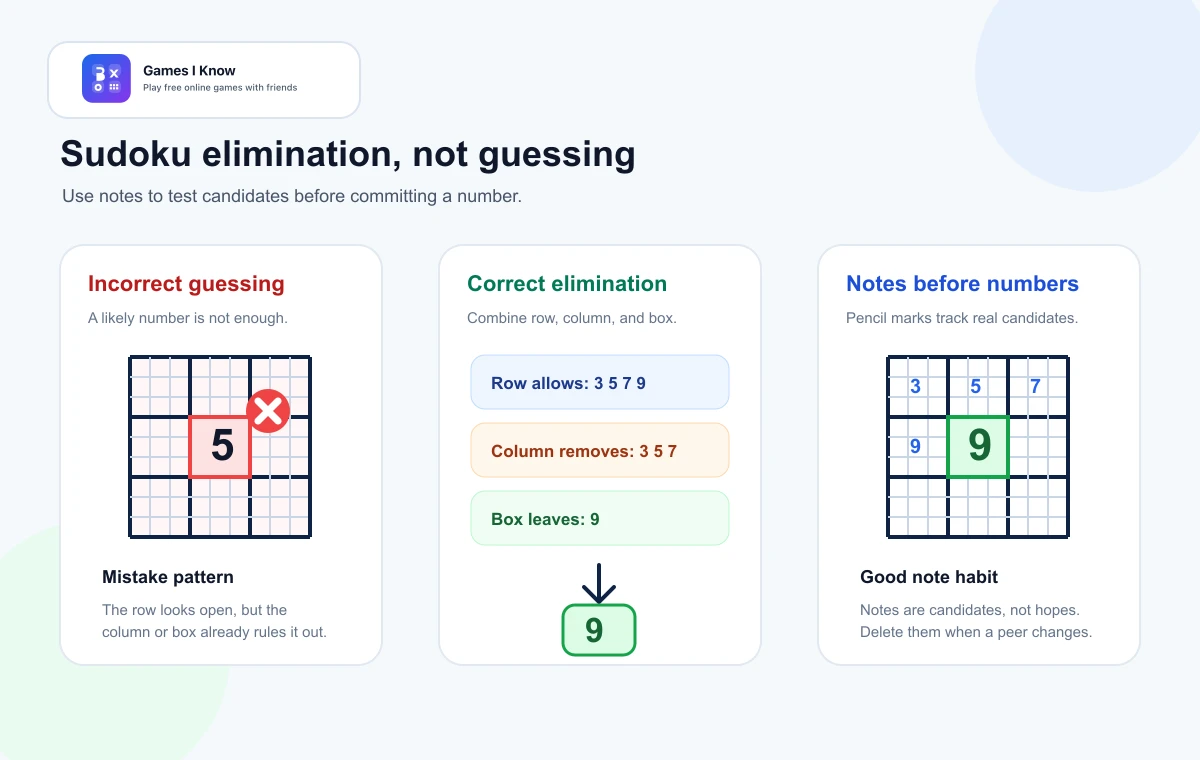
Here is a small elimination routine you can use on any Sudoku board. Imagine an empty cell in the top-left box. You want to know whether 5 can go there.
- Check the row. If 5 already appears in that row, remove 5 from the cell.
- Check the column. If 5 already appears in that column, remove 5 from the cell.
- Check the 3x3 box. If 5 already appears in that box, remove 5 from the cell.
- Repeat the same test for the other possible numbers.
- If only one number survives, commit it. If two or more survive, leave notes and move on.
The key is that elimination is not a feeling. It is a reason. A number belongs only when the alternatives have been ruled out by the row, column, box, or by a hidden-single pattern inside one of those groups.
Beginner vs Experienced Sudoku Player
| Situation | Beginner habit | Experienced habit |
|---|---|---|
| Starting a puzzle | Looks for any blank cell | Starts with crowded rows, columns, and boxes |
| A cell has two options | Guesses one | Adds notes and waits for more evidence |
| A number seems missing | Checks only the row | Checks row, column, and box |
| After placing a number | Keeps moving | Updates nearby notes and scans intersections |
| Getting stuck | Stares at the same area | Rotates to another row, column, or box |
| Using the timer | Rushes to reduce time | Builds accuracy first, then improves speed |
Signs you are improving at Sudoku
- You can explain why a number belongs before you place it.
- Your notes get smaller as the puzzle progresses instead of larger and messier.
- You notice crowded boxes and rows early.
- You switch areas calmly when one part of the grid stalls.
- You find hidden singles more often.
- Your mistake count drops before your solve time drops.
- Medium puzzles feel slower but not mysterious.
Common myths about Sudoku
Myth: Sudoku is about math
Classic Sudoku uses digits, but it is not arithmetic. You are not adding or multiplying. You are placing symbols by logic: each row, column, and 3x3 box needs the digits 1 through 9 without repeats.
Myth: Fast players are always guessing
Good players often look fast because they recognize patterns quickly. The move is still based on a rule. Speed comes from practice, not from skipping evidence.
Myth: Notes are only for hard puzzles
Notes are a beginner tool too. Easy puzzles can teach you how to record candidates cleanly without getting overwhelmed.
Myth: A mistake means the whole puzzle is ruined
A mistake is feedback. Games I Know highlights wrong user-entered values and tracks mistakes, so you can slow down and rebuild the habit that failed. The lesson matters more than the single board.
How to practice on Games I Know Sudoku
A practical beginner session is short and focused. Open Sudoku, choose Easy, and play one puzzle with no guessing. Use the mistake counter as feedback, but judge the session by reasoning quality: did every committed number have a row, column, and box explanation?
| Difficulty | Verified setup | Practice goal |
|---|---|---|
| Easy | 9x9 grid with 40 givens | Build the three-check habit and avoid guesses |
| Medium | 9x9 grid with 32 givens | Use notes consistently and find hidden singles |
| Hard | 9x9 grid with 26 givens | Practice slower candidate management |
The current Sudoku game does not need a download or signup for normal play. It works on phones, tablets, laptops, and desktops. On desktop, keyboard controls support arrow movement, number entry, notes toggle with N, and clearing with Backspace or Delete. On touch screens, select a cell first, then choose a number or toggle Notes from the on-screen controls.
Final takeaway
The best Sudoku strategy for beginners is not a fancy technique. It is clean decision-making: check all three areas, write only real candidates, update notes after every confirmed number, and resist guessing when the board slows down. Practice that routine on Easy puzzles first, then move up when the habit feels natural.
Related games & embeds
Explore Games I Know pages connected to this guide.
Frequently asked questions
What is the most common Sudoku mistake?
The most common Sudoku mistake is guessing before a number is proven. A guess can create false certainty and make later moves harder to trust.
How do beginners avoid Sudoku mistakes?
Beginners avoid Sudoku mistakes by checking the row, column, and 3x3 box before every placement, using notes for candidates, and moving to another area when a cell is not proven.
Is guessing bad in Sudoku?
For beginners, guessing is usually bad because a wrong guess can mislead the rest of the solve. Use notes and elimination instead of committing uncertain numbers.
What are pencil marks in Sudoku?
Pencil marks are small candidate notes that show which numbers could still fit in a cell. They should be based on row, column, and box checks, not hunches.
What is a hidden single in Sudoku?
A hidden single is a number that has only one possible position in a row, column, or 3x3 box, even if that cell has multiple candidates written in it.
Should Sudoku beginners use notes?
Yes. Notes help beginners preserve uncertainty instead of guessing. They are most useful when they record only candidates that truly fit the row, column, and box.
How can I improve at Sudoku?
Improve at Sudoku by practicing one habit at a time: start with crowded areas, prove every move, update notes after each placement, and review mistakes instead of rushing to harder puzzles.
Does Games I Know Sudoku have hints?
The current Games I Know Sudoku play surface focuses on direct solving with notes, clear cell, mistake tracking, timer, difficulty choices, keyboard controls, and touch-friendly input. It does not include a hint button.
Can I play Sudoku online for free?
Yes. Games I Know offers free online Sudoku in the browser. You can choose Easy, Medium, or Hard and play without a required download or signup.
Related articles
June 25, 2026·12 min read
How to Play Sudoku Online: Rules, Tips, and Difficulty Guide
Learn how to play Sudoku online with simple rules, beginner tips, notes mode, difficulty guidance, and a free browser puzzle you can open on any device.
July 13, 2026·9 min read
Word Search Tips: How to Find Words Faster Every Time
Use practical Word Search tips to find words faster: scan by direction, spot uncommon letters, use word length, avoid beginner mistakes, and practice online.
April 18, 2026·3 min read
Quick games to play online when you have 5 minutes
Discover quick browser games you can play online in just a few minutes. No login, no download - just open a game and start playing.
April 28, 2026·3 min read
Games to play when bored on phone or laptop
Need something fun right now? Here are the best games to play when bored, with fast picks for solo breaks, duos, and small groups.
April 30, 2026·3 min read
Free online games with no download or signup
Find free online games with no download or signup. Learn what to look for, what to avoid, and which game formats start fastest.
May 1, 2026·4 min read
Fast free browser games for quick group play
Discover fast free browser games you can open in a tab with no download. Great picks for duos, small groups, and quick breaks on phone or desktop.
Get in touch
Questions about this topic?
Send support questions, embed requests, partnership ideas, or feedback. Your message is saved securely and forwarded to our support channel for review.